
Research Area
Research Focus 2: Raman Spectroscopy
The Problem
While optical trapping within a micro-Raman setup is now a relatively standard procedure, a fundamental physical limitation known as the diffraction limit has historically resulted in Raman signals being a composite of signals originating from all subcellular structures within the measurement volume and their surroundings. Consequently, achieving high specificity and extracting information from the subcellular structures of live bacterial cells via Raman spectroscopy has remained a significant challenge.
Our Research
Raman spectroscopy offers a non-destructive, reagent-free, specific, and broadly applicable method for examining the molecular characteristics of both living and non-living matter. Our research aims to apply this technique, combined with optical trapping methods, to investigate live bacterial and virus particles. We use two optical trapping methods: free-space Raman trapping and nanophotonic Raman trapping.
Highlights
- Our theoretical investigations into Brownian motion within an optical trap reveal that different subcellular structures exhibit varying Brownian motion patterns, enabling subcellular analysis via modulated signals.
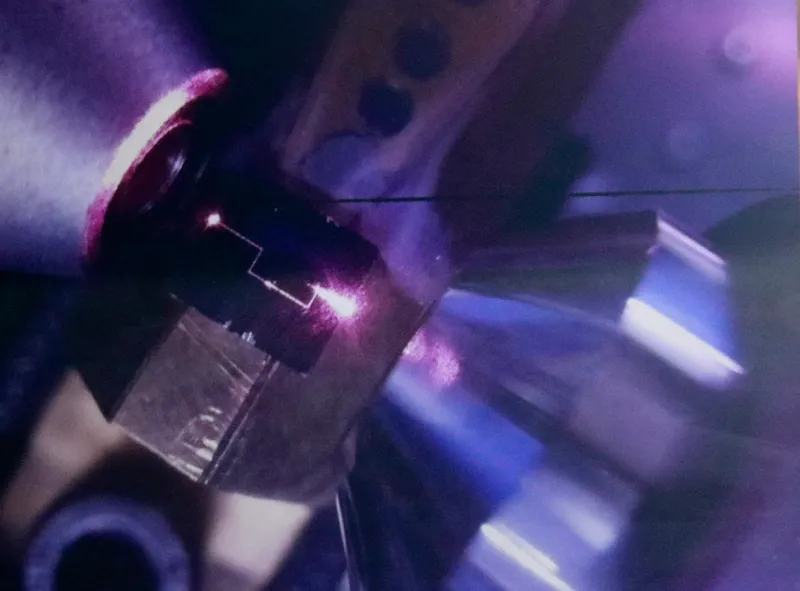
- Nanophotonic Raman traps use the evanescent optical field near photonic waveguides — mass-producible for a few dollars, amplifying Raman signals by up to four orders of magnitude.
- If successful, this technology holds the potential to revolutionize diagnostics in resource-limited areas, particularly within developing countries.
Funding
This project is partially funded by The World Academy of Sciences (TWAS)/sida/UNESCO.
Sample Publications
- R. Sharma, et al. "Distinguishing chemically similar particles in a complex environment via modulated field spectrometry." Optics Continuum 2.2 (2023): 303-311.
- A. Dhakal et al. "Nanophotonic waveguide enhanced Raman spectroscopy of biological submonolayers." ACS Photonics 3.11 (2016): 2141-2149.