
Research Area
Research Area 2: Diffuse Correlation Spectroscopy
The Problem
Studying microorganisms typically requires expensive and complex microscopy systems, which are not easily accessible in developing countries. However, we've found that it's possible to gain specific information about these organisms without necessarily imaging them in their real-life forms.
Our Research
Our approach utilizes Diffuse Correlation Spectroscopy (DCS), a computational optics technique. DCS works by sensing minute changes in the path of a light beam through laser speckle analysis. This method has been successfully applied by our partners at the University of Glasgow for heart and brain diagnostics. We are now adapting DCS to detect and study microorganisms, particularly those responsible for diarrheal diseases.
Highlights
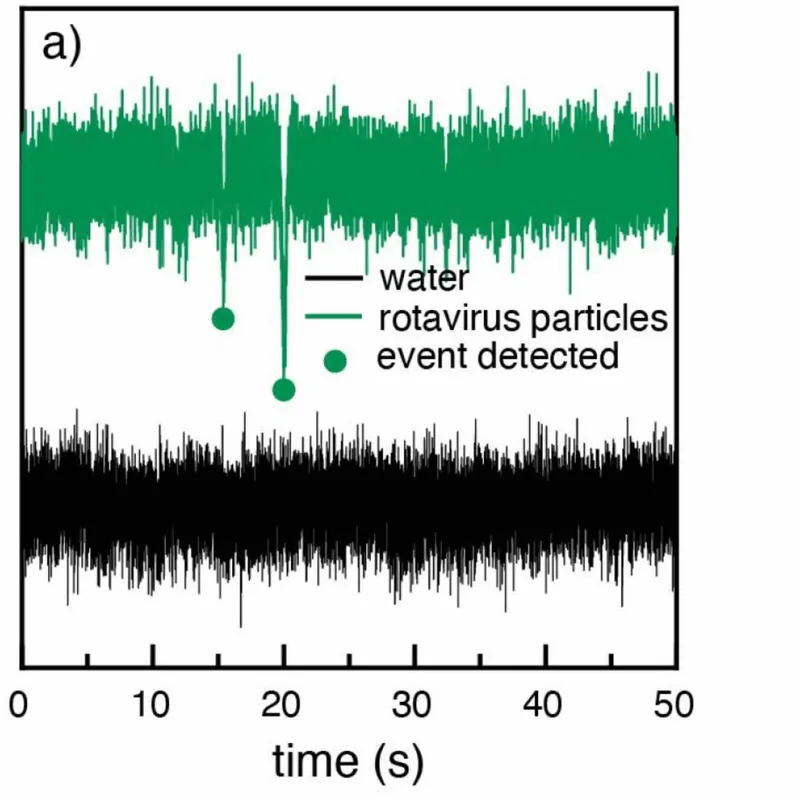
- Signals from rotavirus particles measured using light scattering.
Funding
This project is partially funded by University of Glasgow’s GCID Small Grants Fund.
Sample Publications
- A. Dahal, et al. "Low-cost Dynamic Light Scattering to Detect Rotavirus Particles in Drinking Water." in Frontiers in Optics + Laser Science 2024 (FiO, LS), JD4A.50
- Cester, Lucrezia, et al. "Remote laser-speckle sensing of heart sounds for health assessment and biometric identification." Biomedical Optics Express 13.7 (2022): 3743-3750.