
Research Area
Research Focus 1: Autofluorescence Spectroscopy
The Problem
Developing societies face significant challenges in accurately detecting and effectively treating diseases, largely due to limited access to diagnostics. This issue is compounded by the overuse of broad-spectrum antibiotics, often administered without proper diagnostic procedures. To address this, a comprehensive understanding of diseases and pathogens, their metabolic processes, and relevant biomarkers is essential for creating affordable and easy-to-use diagnostic and treatment methods.
Our Research
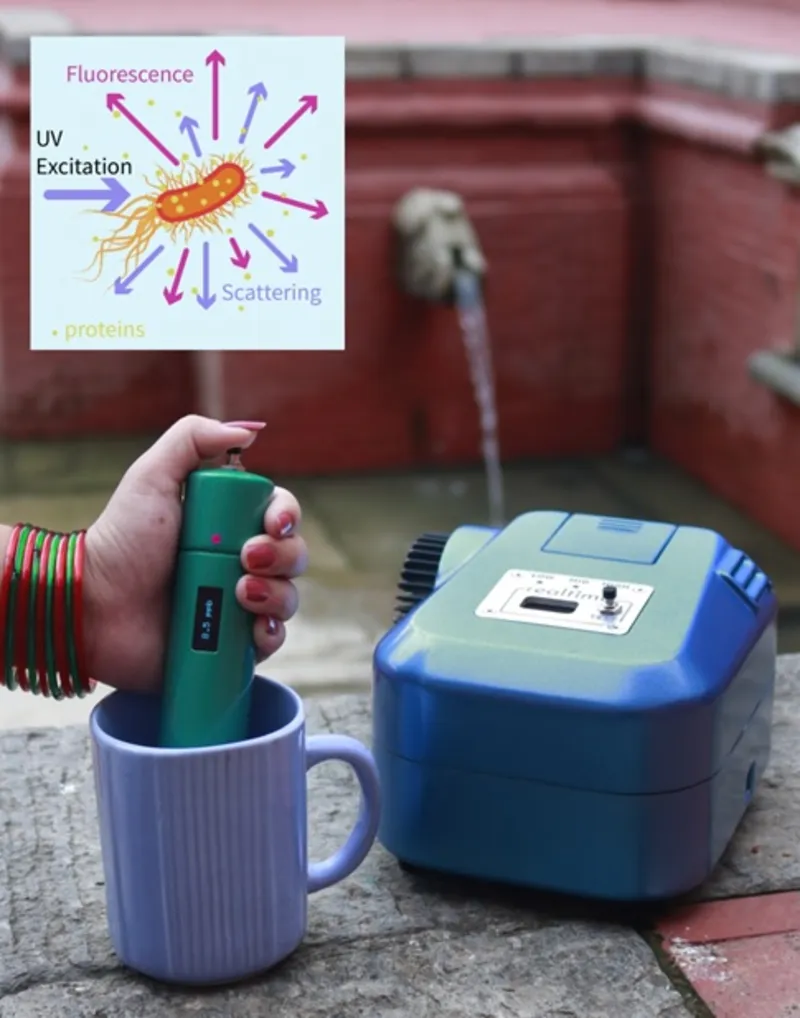
Many biomolecules, upon absorbing light, become excited and then rapidly relax, re-emitting light at a lower energy. This emitted light, called fluorescence, offers crucial insights into the molecules. While reagents are often used to boost fluorescence for studying minute molecular quantities, our research focuses on developing reagent-free methods. We aim to achieve this through several approaches, including: (a) improving instrumentation, and (b) gaining a deeper understanding of energy exchange between biomolecules, allowing us to probe the same biomolecules through various interactions with different molecules.
Highlights
- Fluorometric systems with sub-ppb sensitivity, developed using our groundbreaking methods.
- Our new analytical method identifies fecal coliforms with unprecedented sensitivity and specificity.
- Improving instrumentation through radical approaches such as lens-free fluorometry.
Sample Publications
- A. Maharjan, et al. "When a lensless fluorometer outperforms a lensed system", Optica 11, 1124-1128 (2024)
- A. Dahal, et al. "Autofluorescence spectroscopy meets UNICEF’s target for water quality detection", preprint on ResearchSquare (2025) — doi:10.21203/rs.3.rs-6918655/v1